
"Ama Knows Three Tones I Don't. She Tells Me" by Cassidy Ling

Ama Knows Three Tones I Don’t. She Tells Me
“Ama doesn’t speak English.” Grandma’s worn hands
gift me half
the truth. “Use Mandarin,” Ama insists
because it is her mother tongue
and it is mine as well
except I cannot name any city
between Taipei and Kaohsiung along the railway.
Ama teaches me incantations, half
spells, jaw clenches
speaking spinback shaped by her inflections,
tongue twisters stick
the five tones to my lips,
Māmȧ mà má mǎ.
One for each knuckle that cups my ears.
Mom scolds the numb horse.
She licks each fingertip
as she flips through a story:
she walks me through an imaginary farm,
urging me to list every animal
so I learn the difference
between niú (cow) and zhū (pig) and yā (duck)
before snapping the book closed
and testing me on the new words,
teasing me for every animal I’ve forgotten.
“Nǐ zhī dào (you know that)
tái yǔ bù zhǐ yǒu (Taiwanese is not only)
wǔ gė shēng diào (five tones)
yǒu bā gė (but eight).”
The octet remains unfamiliar to me
even though in Mandarin
bā (eight) sounds like fā (good fortune)
and I am addicted to the smiles
of the Asian parents sitting on the sidelines
when they catch the #88
on the back of my soccer jersey
because we understand each other
beyond black hair,
bubble tea, pineapple cakes,
and the dull sweetness of sun-dried persimmons
in the middle of autumn.
But in Taiwanese,
the language that will never reach me
in California,
eight is peh,
not lucky. Empty like Ama’s breath
when she scoffs at the 888 necklace lying
on my chest,
never an angel number,
no longer abundant with identity
because I will never be completely Taiwanese
clinging onto the only five tones I have.
From the front seat
of the minivan
she speaks to my mother in code
that becomes the fog on the I-80.
From the back seat
I ask her to pass along a phrase or two,
but she refuses because it is three tones too heavy
for an American mouth to hold.
And even if I listen to her on the phone,
even if I practice pronunciation,
even if I mimic the way her words fly like bullets
that shoot down any doubt
we share an origin,
who could I talk to anyway?
And yet she laments that the language decays,
nasal tones pried out until they are forgotten
amongst the Mandarin metropoles.
Still, she withholds
the three extra tones
that she describes as useless
for a girl who visits the same city every year,
a girl that hasn’t spent more than half
of a day in the rural south
where the dialect is still rich.
But my smile lines are shaped
like the lines in her palms,
and the way I whisper “zǎo ān (good morning)”
to her in the kitchen every morning
matches her pitch.
When she cannot contain
my head within her hands anymore,
she gives in to my requests
and teaches me one phrase:
To siā (thank you).
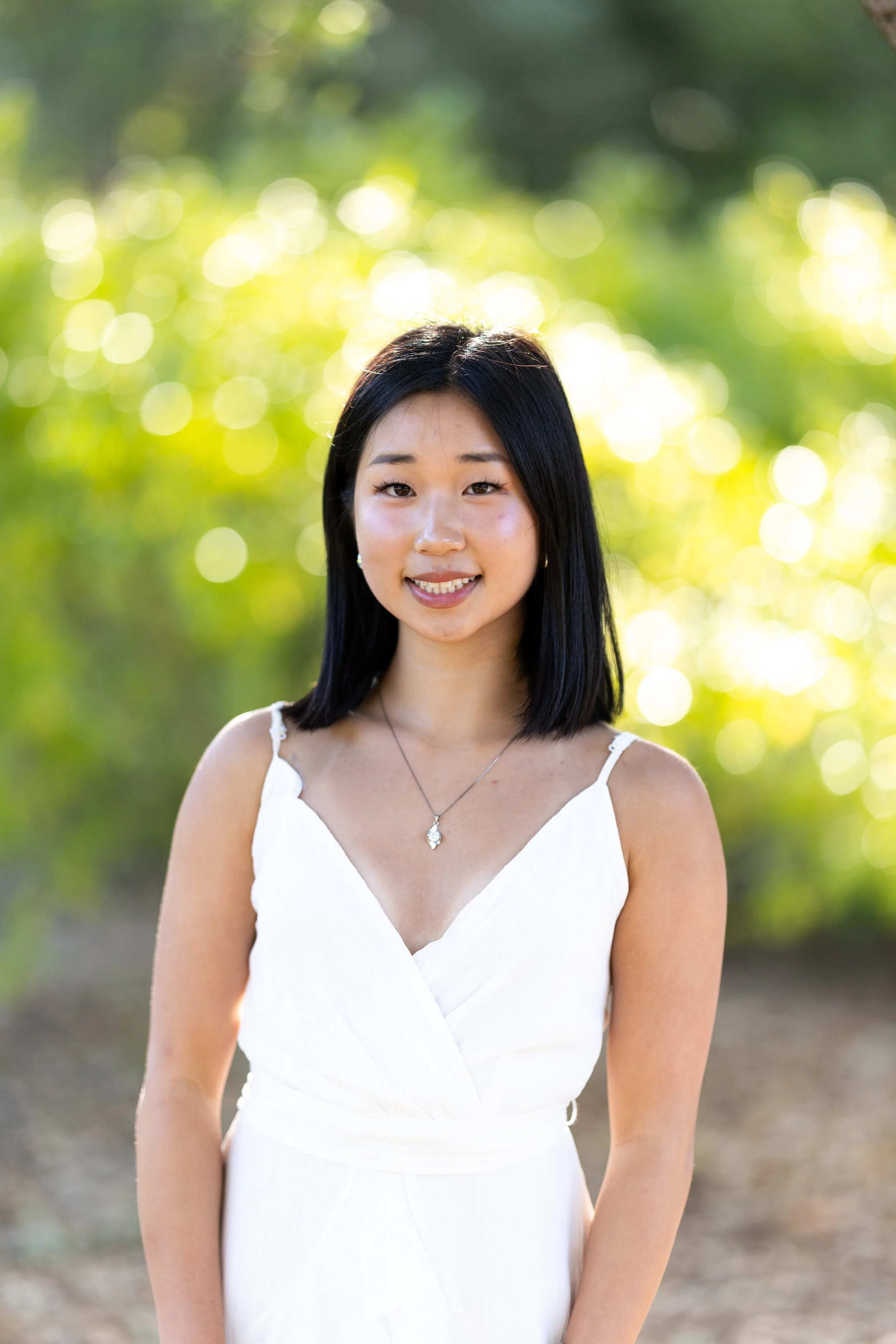
Cassidy Ling is a Taiwanese American writer from California. She enjoys writing about cultural heritage, self-discovery, and experiences that are relatable, yet distinct in their "flavor." She is bilingual in English and Mandarin, often integrating both aspects of her identity into her pieces as she grapples with how to not only translate between languages, but between memories and words on the page.
Instagram: @cassie_dumpling