
"Miss Abernathy’s" by Stephen Aldrich
Miss Abernathy’s
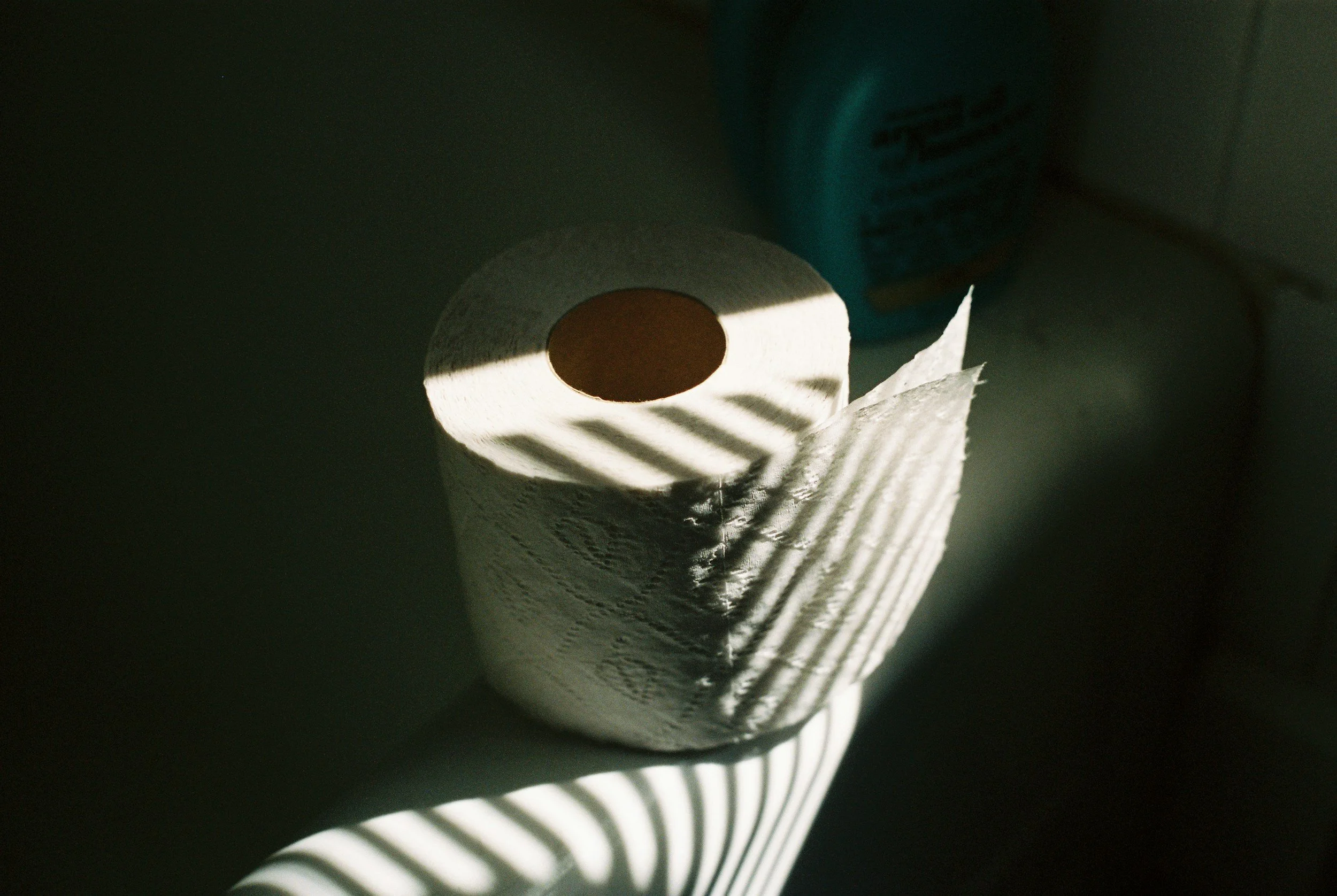
The worst toilet paper in the world is the kind at Miss Abernathy’s. It’s that ultra-thin, see-through stuff that has to be balled into a quadruple-thick mound to even be usable, the kind that was probably invented by Saddam Hussein so that he wouldn’t be the only one to get his hands dirty. It makes you think twice about going, stirs up fantasies of tissue paper, and is found at gas stations and greyhound depots the world over. My Mama buys Charmin. Miss Abernathy gets Saddam Squares.
I say gets, not buys, because Miss Abernathy’s bathroom, as well as the rest of her house, is maintained by her son, Mr. Ross, a man who, I have decided, hates her. I believe this to be shown not only on the basis of her toilet paper, which is about as far from the ideal as New York is from Belize, but also on the quality of her soap and shampoo bottles, which are always hotel brand and travel-sized, the dental floss (which yes, I did sample, because once I got part of a fish sandwich stuck in my teeth and it was driving me crazy so I asked Miss Abernathy if I could use some and she said Fine fine), which comes apart instantly upon contact with the teeth, and by the food provided for her, that being a fairly predictable rotation of canned soups and instant rice packets, with the occasional perishable sprinkled in. Plus, from what I can tell, household repairs are, at best, seen to by hillbilly hopefuls, while minor replacements, such as lightbulbs, pull chains, batteries, and goldfish, are never addressed, so that the house feels forever in disrepair, the kind of place that might be kept by a terminally-ill loner, as opposed to a home maintained for one. All of these have led me to believe that Mr. Ross hates her. And, of course, because he’s brought me on as the caretaker.
Not that I am, per-se, a bad candidate. My body is functional enough to “cook,” to “clean,” to “maintain the household”: I can shake dead skin out of sheets, help the old woman to the toilet, moisturize her hands and face, and whatever else needs doing. Having taken care of three younger siblings for exactly half of my life, I feel that, at sixteen, I have more expertise than most in these areas, which, as my mother occasionally mumbles out to me from her sanctuary on the living room couch, sprawled out, feet dangling off the end, washcloth on her forehead with the light down low, “Is no small accomp-lishment, no small—ahh—”
Still, the fact that Mr. Ross requested a girl from Hands of Love—a girl who happens to be serving mandatory community service for “crimes committed”—really suggests a lack of seriousness for his filial obligations. At least in my opinion. A “criminal,” I believe, is very much bottom of the barrel caretaker material.
Not that I allow this to affect how I relate to her.
Truthfully, it is my preference not to relate to her.
Truthfully, most of the tasks assigned to me don’t require any interaction with her at all, thank God, so that most of my time (two hours after school Monday and Thursday, four hours on Saturday) can be spent playing games like: let’s see how long I can go before Miss Abernathy notices that I am here, or: let’s see how long I can pretend I didn’t hear her calling from the top of the stairs because my headphones were in and I was concentrating on my homework, or: let’s see how long I can pretend that I’ve never heard of that card game she taught me last week, or that I’ve forgotten how to set the T.V. to the appropriate amount of volume, or have forgotten the look of horror that flashed across her face when I first came through the door, which, though quickly covered up, nonetheless suggested that several White Words were probably still alive and well in her vocabulary, a suggestion which will probably never become unstuck from my mind, no matter how much dental floss she allows me.
Hence the not relating.
When I can get away with it.
Because of course, sometimes I am also forced to. Sometimes, in addition to taking out the trash, running the dishwasher, cleaning, and the like, my list of tasks includes making sure that “Mom” gets her pills, meaning that I must stand behind her like a sentinel and ensure that she keeps her vitamin and cholesterol levels in tip-top shape. Sometimes, I am required to help her in the bathroom, meaning that, for five to fifteen minutes, I must play the role of walker, arm rail, bidet, and attentive listener, while also volunteering opinions of my own on subjects as widespread as The War on Terror, Gilmore Girls, That-Idiot-John-Kerry, and the softness of her stool, sometimes in the same breath. And sometimes, after these initial ablutions, I have to complete the ceremony by rolling up my sleeves and soaping her in the shower, moving that inch-long orange rectangle across skin so wrinkled it could be studied in a cartography class, during which she will often ask personal questions of me, a subject not so intimidating, it seems, as when we were huddled over the remains of her dinner of frozen peas and corn, to which I often dutifully reply, though not always honestly, all while trying to avoid the obvious subtext of which we are both aware: that everything I say I want, her wrinkled titties have already received, and that everything I say I dread, she has never had to go through, meaning that my life will come to this (or worse) at the end, and that while I am washing history, I am also being given a glimpse of my future.
Which, naturally, I do my best to ignore.
For you see, having some sixteen-year-old girl being my personal poo-shepherd is far from my idea of a good time. Having to spend the bulk of my days alone, lying in bed, watching reruns on television, with the only proof of an outside world being the news, Joel Osteen, and a handful of disinterested visiting parties, would serve only as confirmation to me that Hell is real and that I am in it. It’d be enough to make me want to end it. For isn’t the beauty of life found in the living of it, in the walking out your door and going anywhere you please, or taking a rest in a park somewhere, cloud and sun above, dandelions grazing your calves, or going out for dinner with people who love you, and then repeating variations on this theme, day after day, year after year, until—poof—you run out of them? And if that’s true, if that’s what true living is supposed to be, how can she not be sick of hearing from Dr. Joel that she deserves prosperity, only to turn off the T.V. and gaze at her swollen toes and her undernourished life? Why is she not tired of forcing herself to smile as she greets me each day, as if a gangly juvenile delinquent is her dream visitor, or of calling out to her son when he comes by to drop off groceries, only to be ignored and never kissed goodbye? How doesn’t she cry herself to sleep each night? How doesn’t she, when she’s in charge of her own pills, just wing it and take a half-dozen more?
And I guess this is why I do my best to ignore her, even though I know it contributes to her revolting state and my paralysis in the first place. Because, if I didn’t—if, say, I allowed myself to finally see what was going on, to get riled up the next time she gets shit on her fingers because the toilet paper tears, or to defend her the next time Mr. Ross drops by during one of his surprise check-ins and, seeing us at cards, says, “You know, Liv, you don’t have to entertain her,” loud enough for us both to hear, or even if I just spent more time contemplating the general nature of her existence, picturing her whittling away her last, lonely hours into that nubby little shank she should have been preparing for God these last few years—then I’d have a hard time concentrating on my homework, right, a hard time dealing with my own problems—societal ostracization, my siblings’ needs, my classmates’ catcalls of “Mug Shot Lennox,” to name a few—and might, out of a burst of obvious madness, accidentally care enough to do something for her, to sneak over some afternoon with a wheelchair and just prison-break her out of there, destination Central Park, or perhaps a contemporary film, before plowing her through a crowd of self-absorbed dandies to an actual CVS, where I will ride her chair like a shopping cart in search of some real L’Oreal, after which we will return home, both of us flushed, dewy-eyed wonders, and where I will say “See you next time, Miss Abernathy,” hoping beyond hope that she will offer a sentence of appreciation of her own, betraying behind those glasses some flicker of understanding, that our adventure has changed us both, forever and completely, so that the next time I arrive, she will cajole me to go, and we will repeat our escapes, again and again, until—poof—we run out of them—something which, I admit, I would die for—because honestly it gets lonely, this place that I’m in, with my problems, the demands, and this borderline-senile woman as my closest friend—so that really, I suppose, there’s no harm in pretending, if only for a moment—that when those rheumy eyes close their last, she will be comforted in knowing that, better than God, or money, or that sack of shit son, exists Lividia Lennox, granny-napper at large.

Stephen Aldrich is a writer from Columbus, Ohio. Though he primarily writes short fiction, he also plays tennis, hikes, and teaches young children.